[5주차 - Pivot Table]
[문자가 들어있거나/ 값을 가지고 있는 않은 상황/ join한 테이블이 값을 가지고 있지 않을때]
방법 1: 없는 갑을 제외해주기

'NULL은 없다'는 의미 즉, if(----,----, null)->조건에 충족하지 않으면 없는 걸로 취급해줘!
1) avg (rating) average_of_rating : 'not given'을 0의 값으로 처리 즉, 0,0,5,3,4,3 /6으로 평균구함
2) Null 사용 -> 5,3,4,3/4로 없는 자료값으로 취급
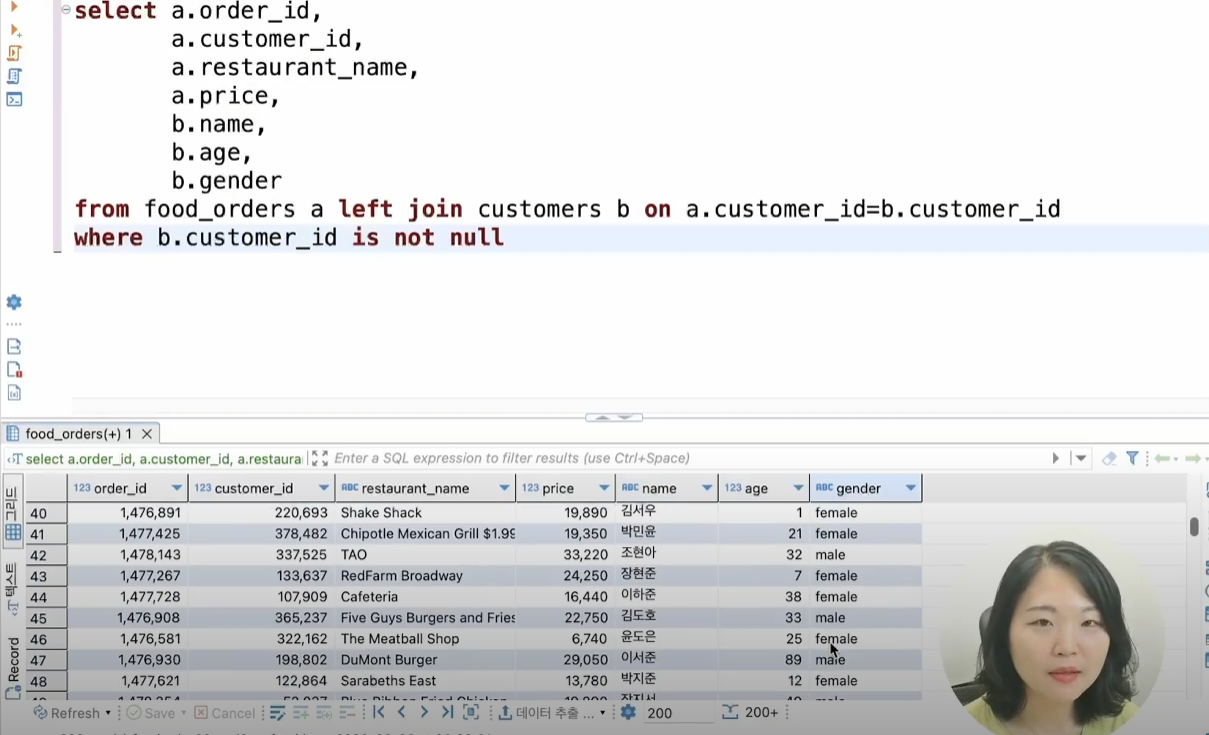
>left join사용후, 자료가 없어 null로 표기되는 부분들을 없애고 싶다면, 'is not null'을 사용해 제거
방법2: 다른 값 대신 사용
(평균값 혹은 중앙값 등 대표값을 이용하여 대체해주기도 함)
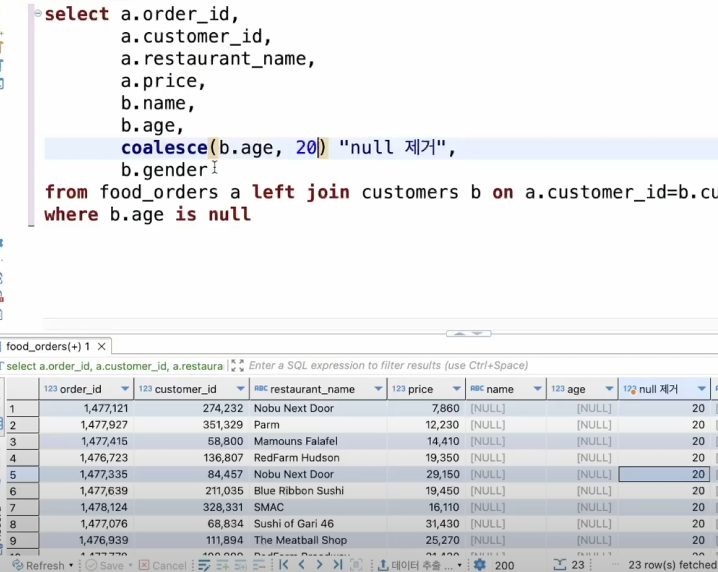
| a) 조건문 이용: if( rating>=1, rating, 대체값) -> 다른 값이 있을 때 유용 b) coalesce (age, 대체값) -> null 값일 때 |
[Pivot Table]
: 2개 이상의 기준으로 데이터를 집계할 때, 보기 쉽게 배열하여 보여주는 것
[실습]
음식점별 시간별 주문건수 Pivot Table 뷰 만들기 (15-20시 사이, (시간은 앞 두글자만)20시 주문건수 기준 내림차순)
| select restaurant_name, . -> 첫 행 max(if(hh='15', cnt_order, 0)) "15", -> max를 무조건 붙여야함 max(if(hh='16', cnt_order, 0)) "16", max(if(hh='17', cnt_order, 0)) "17", max(if(hh='18', cnt_order, 0)) "18", max(if(hh='19', cnt_order, 0)) "19", max(if(hh='20', cnt_order, 0)) "20" from ( select a.restaurant_name, substring(b.time, 1, 2) hh, count(1) cnt_order from food_orders a inner join payments b on a.order_id=b.order_id where substring(b.time, 1, 2) between 15 and 20 group by 1, 2 ) a group by 1 ->max/ sum/ avg처럼 계산하는 함수가 들어가면 꼭 그룹해줘야함 order by 7 desc |

[window 함수]
: 각 행의 관계를 정의하기 위한 함수로 그룹 내의 연산을 쉽게 만들어줌
=> 행은 그대로 유지한 채, 순위, 누적합, 이전값 비교 등을 계산
[구조]
| window_function (argument) over (partiton by 그룹 기준 컬럼 order by 정렬기준 |
-window_function: 기능 명 사용 (sum, avg, rank등)
-argument: 함수에 따라 작성하거나 생략
-partiton by: 그룹을 나누기 위한 기준 (group by와 유사)
-order by: window function 을 적용할 때 정렬 할 컬럼 기준
[실습]
음식 타입별로 주문 건수가 가장 많은 상점 3개씩 조회하기
| select cuisine_type, restaurant_name, order_count, ranking from ( select cuisine_type, restaurant_name, rank() over (partition by cuisine_type order by order_count desc) rankig, order_count from ( select cuisine_type, restaurant_name, count(1) order_count from food_orders group by 1, 2 ) a ) b where ranking<=3 order by 1, 4 |

1.음식타입별, 음식점별 주문 건수 집계
2. Rank 함수 적용 -> 계산 대상이 없고 순위를 메기는 거기 때문에 ()안은 비워두기
3. 3위까지 조회, 음식타입별, 순위별로 정렬
[실습]
각 음식점의 주문건이 해당 음식 타입에서 차지하는 비율을 구하고, 주문건이 낮은 순으로 정렬했을 때 누적 합 구하기
| SELECT cuisine_type, restaurant_name, cnt_order, SUM(cnt_order) OVER (PARTITION BY cuisine_type) AS sum_cuisine, SUM(cnt_order) OVER ( PARTITION BY cuisine_type ORDER BY cnt_order) AS cum_cuisine FROM ( SELECT cuisine_type, restaurant_name, COUNT(1) AS cnt_order FROM food_orders GROUP BY 1, 2 ) a ORDER BY cuisine_type, cnt_order; |

[날짜 데이터]
date (컬럼명): 문자 형식의 데이터를 날짜 형식의 데이터로 변경
date_format(date(컬럼명), (%Y/ %M/ %D/%W))
L데이트를 형식화 해줘!
예)
| select date(date) date_type, date_format(date(date), '%Y') "년", date_format(date(date), '%m') "월", date_format(date(date), '%d') "일", date_format(date(date), '%w') "요일" from payments |

요일: 0은 일요일, 1은 월요일을 의미
[실습]
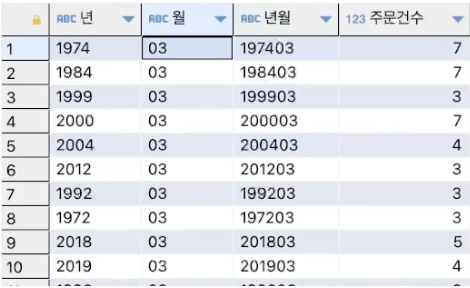
년도별 3월의 주문건수 구하기
| select date_format(date(date), '%Y') "년", date_format(date(date), '%m') "월", date_format(date(date), '%Y%m') "년월", count(1) "주문건수" from food_orders a inner join payments b on a.order_id=b.order_id where date_format(date(date), '%m')='03' group by 1, 2,3 order by 1 |